GLP-1 medications are covered by many U.S. insurance plans, but whether your plan covers them depends almost entirely on why you’re taking them. Prescriptions for Type 2 diabetes, including Ozempic (semaglutide) and Mounjaro (tirzepatide), get covered far more consistently than the same drug class prescribed for weight loss alone. That single distinction, indication versus indication, drives most coverage denials and approvals.

Two qualifiers matter most right now. First, coverage varies by indication: diabetes and certain cardiovascular indications clear the bar more reliably than obesity-only prescriptions. Second, Medicare launched a GLP-1 Bridge program in 2026 that creates a temporary, structured pathway for certain beneficiaries to access weight-loss drugs at a fixed monthly copayment.
Your 10-minute action list:
If you want a faster answer, use an online coverage-check tool. NovoCare’s form, for example, can return a plan-specific cost estimate in minutes and generates a summary you can hand directly to your clinician or HR department.
Coverage for GLP-1 medications is genuinely common, but the word “covered” hides a lot of variation. For Type 2 diabetes indications, most commercial plans include drugs like Ozempic and Mounjaro on their formularies, often at Tier 2 or Tier 3. For weight management, the picture is patchier.
Employer-sponsored plans are the biggest wildcard. Even when an insurer’s national policy allows weight-loss drug coverage, the employer who sponsors your plan can opt out entirely. That means two people on the same insurer’s network, working at different companies, can have completely different outcomes for the same prescription. If your plan excludes weight-loss benefits, the insurer isn’t the right escalation point. Your HR or benefits department is.
Coverage for weight-loss drugs may be excluded at the employer/plan-sponsor level, which means petitioning HR or benefits is often the correct escalation — not the insurer alone.
Medicaid is even more fragmented. As of early 2026, only a minority of states cover GLP-1s for obesity under fee-for-service Medicaid, and state lists shift frequently. If you’re on Medicaid, check your state’s preferred drug list directly rather than relying on general guidance.
Formulary tiers, step therapy requirements, and prior authorization add another layer. A drug listed as “covered” might still require you to try and fail on a cheaper medication first (step therapy), or it might sit on a specialty tier with coinsurance that runs into hundreds of dollars monthly. The tier placement and any attached requirements are what actually determine your out-of-pocket cost, not the simple yes/no of formulary inclusion.
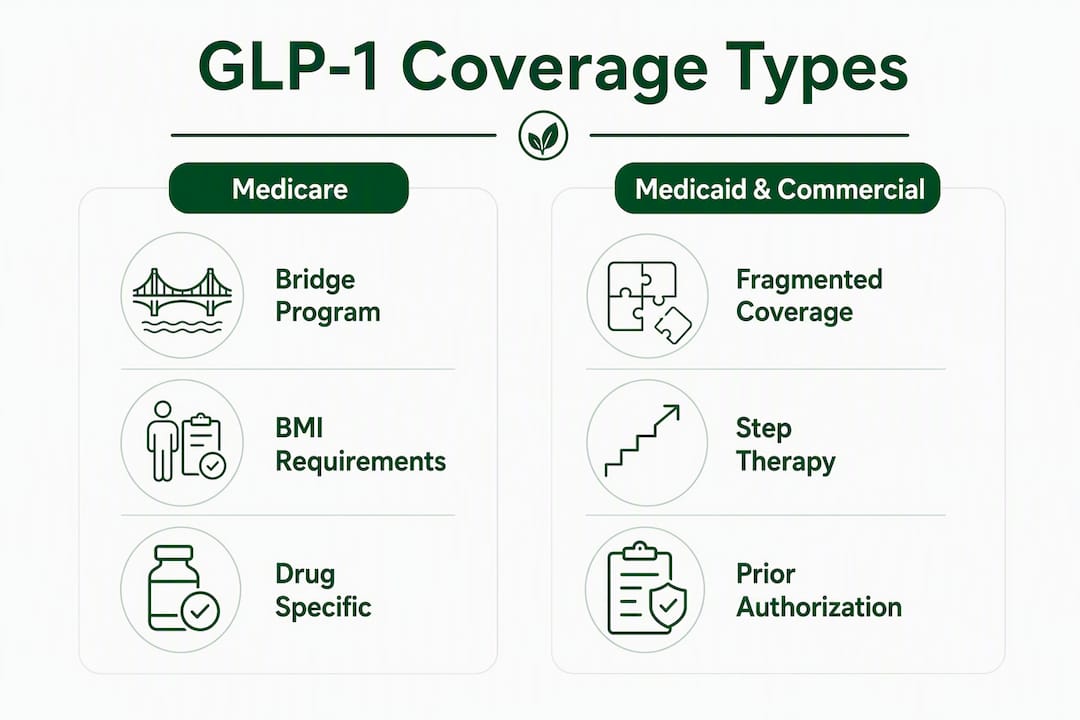

Medicare’s short answer: yes, for specific drugs and specific patients, through a new program. Starting in 2026, Medicare launched the GLP-1 Bridge program, which covers certain weight-loss medications at a fixed monthly copayment for eligible beneficiaries. This is a meaningful shift. Before 2026, Medicare Part D generally did not cover weight-loss drugs, full stop.
The program covers three products: Foundayo (oral semaglutide tablet), Wegovy (semaglutide, both injection and tablet forms), and Zepbound (tirzepatide, KwikPen only). Ozempic and Mounjaro are not listed under the Bridge program for weight loss, though they may still be covered under Part D for their diabetes indications.
| Drug | Form covered under Bridge | Diabetes indication (Part D) |
|---|---|---|
| Wegovy (semaglutide) | Injection and tablet | Not applicable (weight-loss drug) |
| Foundayo (oral semaglutide) | Tablet | Not applicable |
| Zepbound (tirzepatide) | KwikPen only | Not applicable |
| Ozempic (semaglutide) | Not in Bridge | Yes, via Part D |
| Mounjaro (tirzepatide) | Not in Bridge | Yes, via Part D |
One detail that catches people off guard: Bridge program payments do not count toward your Part D deductible or your out-of-pocket maximum. They operate as a separate program entirely. That means reaching the Bridge’s $50 copay threshold won’t accelerate you toward catastrophic coverage under Part D. Plan your finances accordingly.
Eligibility for the Bridge program ties to BMI thresholds and qualifying comorbidities, consistent with the FDA-approved indications for these drugs. Medicare Advantage plans with Part D (MA-PD) and employer/union group waiver plans may handle Bridge program access differently, so confirm with your specific plan administrator rather than assuming standard Medicare rules apply.
Knowing the right questions to ask saves you from a 45-minute hold that ends with a vague answer. Here’s a practical sequence.
Before you call, gather:
Step-by-step coverage check:
Pro Tip: Request the insurer’s clinical coverage criteria document during this call and forward it to your clinician before they submit anything. Matching the prior authorization submission to that document’s exact language is the single highest-impact step for approval.
Most initial denials aren’t final. They’re procedural. The insurer didn’t get what it needed to say yes, and a well-built prior authorization packet fixes that more often than people expect.
What your clinician’s prior authorization packet should include:
The Wegovy insurance coverage guide recommends structuring the submission around the insurer’s own criteria document. That’s not just good advice; it’s the difference between a packet that gets approved and one that gets returned for more information.
Insurers commonly deny initial requests for incomplete documentation. Submitting a comprehensive prior authorization packet that includes BMI history and prior program records increases approval odds significantly.
When to escalate:
If the initial request is denied, you have options. Request a peer-to-peer review, where your clinician speaks directly with the insurer’s medical director. This step alone reverses many denials. If that fails, file a formal appeal. Most plans must respond to standard appeals within 30 days and expedited appeals within 72 hours.
For employer-sponsored plans that exclude weight-loss drugs at the plan-sponsor level, the right move is a letter to HR or the benefits committee, not an insurer appeal. Frame it around total health costs: treating obesity-related comorbidities is typically more expensive than covering the medication. That argument lands better with benefits managers than a clinical one.
| Escalation step | Who initiates | Typical timeline |
|---|---|---|
| Peer-to-peer review | Clinician calls insurer’s medical director | 2–5 business days |
| Internal appeal | Patient or clinician submits written appeal | Up to 30 days (standard) |
| Expedited appeal | Patient or clinician requests urgent review | 72 hours |
| External review | Independent third party reviews denial | Varies by state |
| HR/benefits petition | Patient submits to employer benefits committee | Varies by employer |
Without insurance, GLP-1 drugs carry retail prices that run into hundreds of dollars per month. With coverage, your actual cost depends on your plan’s tier structure, whether you’ve met your deductible, and what copay or coinsurance applies at your tier.
Common cost categories to understand:
Savings options that actually work:
One warning worth repeating: manufacturer coupons are restricted for government insurance beneficiaries. If you’re on Medicare, the Bridge program’s $50 copay is your primary cost-control tool, not a manufacturer card.
GLP-1 coverage policies are among the most volatile in commercial insurance right now. Plans that covered Wegovy last year may have moved it to a higher tier, added new step therapy requirements, or dropped it from formulary entirely at renewal. This isn’t random.
The main drivers are cost management and utilization growth. GLP-1s are expensive, and as more patients qualify and prescribers become more comfortable writing them, plan spending rises fast. Insurers respond by tightening criteria, raising tiers, or requiring more documentation. New clinical evidence, FDA label expansions (such as cardiovascular risk reduction indications), and state or federal policy shifts also push formularies in both directions.
Calendar moments to watch:
Practical monitoring actions:
GLP-1 insurance coverage in the U.S. depends on your plan type, the drug’s indication, and whether you’ve completed the prior authorization process with complete documentation.
| Point | Details |
|---|---|
| Indication drives coverage | Diabetes indications get covered more consistently than weight-loss-only prescriptions across commercial and Medicare plans. |
| Medicare Bridge program | Eligible Medicare beneficiaries can access Wegovy, Foundayo, or Zepbound at a monthly copayment; Bridge payments don’t count toward Part D limits. |
| Prior authorization documentation | A complete packet with BMI history, prior attempts, diagnostic codes, and insurer criteria language significantly improves approval odds. |
| Denials are often reversible | Peer-to-peer review and formal appeals succeed regularly when the submission is complete and tied to the plan’s clinical criteria. |
| FitRx simplifies the process | FitRx connects patients with licensed clinicians, supports documentation for prior authorization, and handles prescription fulfillment through one digital platform. |
Here’s what I’ve noticed in how people approach GLP-1 coverage: they call their insurer first, get a vague answer, and either give up or submit a thin prior authorization that gets denied. Then they assume coverage isn’t available and start paying out of pocket.
The actual leverage point is the insurer’s clinical coverage criteria document. Most patients and even some clinicians don’t know it exists, but it’s the insurer’s own checklist for what a prior authorization needs to say. When a clinician submits a PA that mirrors that document’s language, the approval rate climbs. When they submit a generic letter, it gets returned for more information or denied outright.
The other thing worth saying plainly: employer plan design is a separate problem from insurer policy. If your company’s benefits package excludes weight-loss drugs, your insurer isn’t the one to fight. You need to make the case to HR, and the most effective argument isn’t clinical. It’s financial. Employers who cover GLP-1s often see downstream reductions in claims for cardiovascular events, joint replacements, and diabetes management. That’s the conversation that moves benefits committees.
Appeals are also far more winnable than most people assume. The Penn LDI research on GLP-1 access barriers consistently points to documentation gaps, not clinical ineligibility, as the primary reason for denials. Fix the paperwork, and the outcome often changes.
Navigating prior authorizations, formulary tiers, and savings programs while also managing a health condition is a lot to handle alone. FitRx is built for exactly this situation: a telehealth platform where licensed clinicians handle your consultation, document your medical history in the format insurers expect, and connect you to prescription fulfillment without the back-and-forth of a traditional office visit.

What FitRx handles for you:
If you’re ready to stop guessing about coverage and start with a clinician who knows the process, see if you qualify through FitRx today.
This article is general information, not medical or insurance advice. Confirm current coverage rules with your insurer, Medicare, or a qualified benefits professional for your specific situation.
These are the primary sources worth bookmarking if you’re actively working through a coverage question or appeal.
Keep copies of every prior authorization submission, denial letter, and appeal response in a dedicated folder, physical or digital. If you escalate to external review or switch plans mid-year, that paper trail is what makes your case.

.svg)